



CenExel is proud to highlight the poster presented at the International Society for CNS Clinical Trials and Methodology (ISCTM) Annual Scientific Meeting, February 2023, Washington, DC.
ABSTRACT
Introduction: The Placebo-Control Reminder Script (PCRS) is an empirically-validated tool found to significantly reduce the placebo and nocebo effects in clinical trials by having a rater read a paragraph to the participant which reviews known factors causing these phenomenon. To investigate further validation of the PCRS and as indicated by instrument gold standard validation principles, the current study surveyed PCRS site raters regarding the instrument’s content.
Methods: A 16-item PCRS User Survey was sent via SurveyMonkey to obtain raters’ perspectives on the tool’s design and construct to evaluate face and content validity. Sponsors who licensed the PCRS provided raters’ email addresses. A link to the survey was sent to the raters either by the first author of this poster or by the sponsor. All PCRS responders were informed of why they were receiving the survey, how their email addresses were obtained, the voluntariness and anonymity of survey completion, and the 5 minutes expected duration of completion.
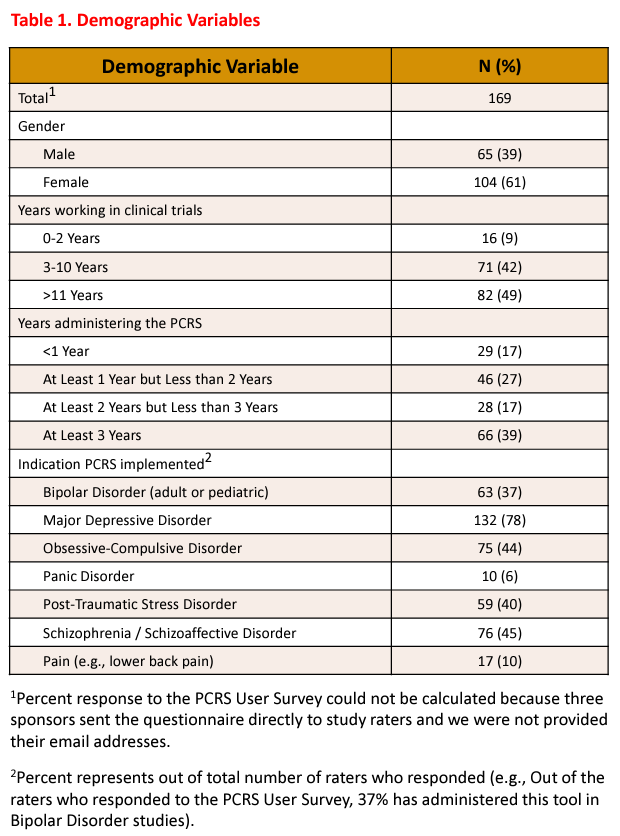
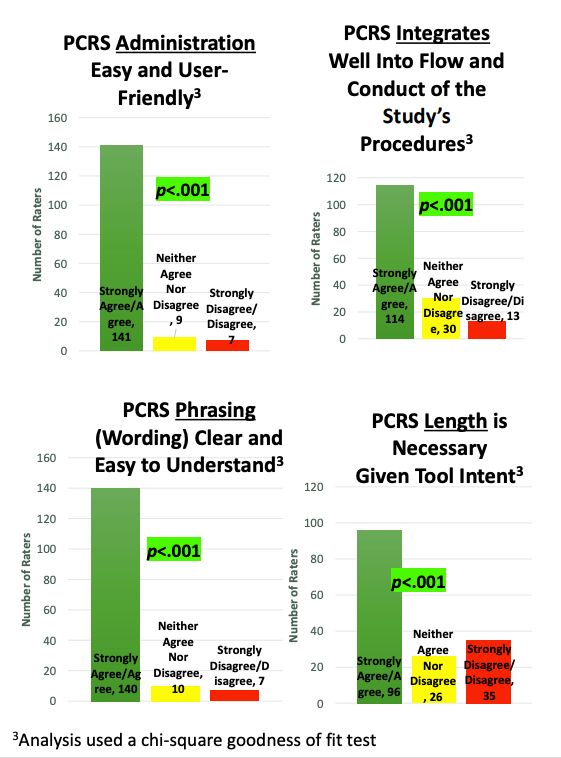
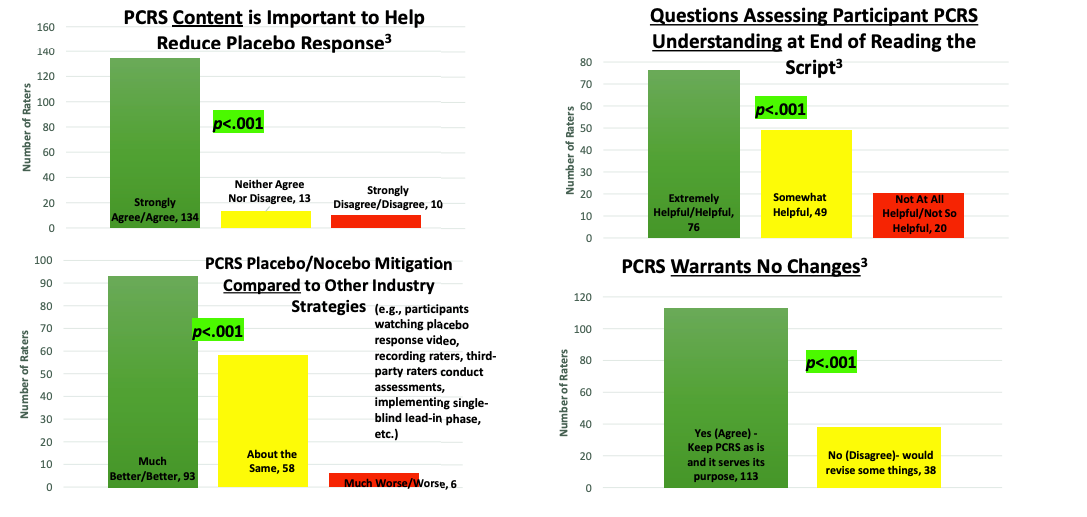
Results: The PCRS User Survey was completed by 169 raters (percent response could not be calculated because three sponsors sent the questionnaire to their raters and we were not provided their email addresses), with a majority of the tool reportedly used in depression (78%) and schizophrenia (45%) trials. Using chi-square goodness of fit test, more raters significantly reported agreeing (rather than neutral or disagreeing) with the PCRS User Survey’s face and content validity questions, including its appropriate wording, phrasing, content, and length aimed to reduce the placebo effect (all factors yielded p<.001).
Discussion: The PCRS has significant face and content validity, with its administrators deeming the instrument highly effective regarding its stated aim of minimizing the placebo response.
BACKGROUND
- The placebo response across various psychological and physiological clinical trial indications continue to permeate within our industry, leading to significant decreases in potential signal detection and thus increasing trial costs (Haflioadottir et al., 2021; Mallinckrodt et al., 2011).
- A meta-analysis of 96 Major Depressive Disorder studies conducted between 1980 – 2005 representing 9,566 depressed participants found a significant positive correlation between placebo response and publication year (p<.001) (Rief et al., 2009). Jones et al. (2021) also found this significant correlation in 50 treatment-resistant depression trials (of 3228 participants).
- Schizophrenia trials also experienced significant placebo response increases (Gopalakrishnan et al., 2020; Rutherford et al., 2014).
- Among 23 antihypertensive clinical trial programs, placebo response increased significantly over time (1990-2016) without a clear explanation as to why after analyzing several physiological and non-physiological potential confounding variables (Khan et al., 2018a). Khan et al. (2018b) found similar results in 19 oral antihyperglycemic agents (23,438 participants and 50 trials).
- Therefore, strategies to reduce placebo and nocebo effects cannot be overemphasized.
- The Placebo-Control Reminder Script (PCRS) has been scientifically verified as a tool which significantly reduces these phenomenon in depression and psychosis indication studies (Cohen et al., 2020).
- The PCRS is a paragraph respective of the study visit which is read by a site staff member (typically the rater) immediately before administering the primary efficacy scale and which thoroughly reviews factors established in the industry as causing placebo and nocebo responses, including expectation bias (Evans et al., 2021; Haflioadottir et al., 2021).
- At the end of its reading, the rater assesses the participant’s comprehension of the PCRS content.
- The PCRS has been licensed since its inception in 2017 in over 25 clinical trials across psychiatric and physiological indications (see Table 1).
- The primary objective of the current study was to advance data on the PCRS’s psychometric property via surveying PCRS raters’ perceptions on training and administration to explore its face and content validity. Evaluating raters’ views to evaluate such validity data is a gold standard method for any ongoing full-scope instrument validation (American Educational Research Association, 2014; Parrott, 1991; Tsang et al., 2017)
- Sponsors licensing the PCRS frequently ask about the scale’s implementation considering other study procedures. Therefore, the secondary goal of the current study was to query site raters about the operational aspects using PCRS in trials.

METHODS
- The PCRS User Survey was developed specifically for the purposes of this study with four demographic questions (e.g., gender and years working in clinical trials), ten 5-point Likert items assessing users’ views on various training and administration standards (e.g., “Agree/Disagree” regarding whether PCRS phrasing was clear and easy to understood given its intention), and three open-ended questions
- Four placebo/nocebo response experts reviewed the PCRS User Survey to ensure questions were straightforward, unbiasedly phrased, and able to complete the objective of this investigation to assess content and face validity of the tool, as well as address sponsor questions regarding the scale’s implementation respective of other study procedures
- To send the survey, all sponsors who have licensed the PCRS were contacted to obtain addresses of the respective study’s PCRS certified (trained) administrators/raters
- Sponsors agreed to either send us the email addresses of the PCRS rater directly to complete the questionnaire via an outside survey company (SurveyMonkey), or directly send the survey link to the raters. Given that three sponsors chose the latter and did not share the raters’ email address with these authors, the survey response rate could not specifically be calculated but we estimate it at 70% given the number of survey responders and number of PCRS study licenses.
- Regardless of distribution method, all PCRS raters were informed of why they were receiving the survey, how their email addresses were obtained, the voluntariness and anonymity of survey completion, to complete the survey only once (thus, duplicate surveys are unlikely), and the 5 minutes expected duration of completion
- Three separate reminders requesting completion were sent to all PCRS raters, including when sponsors directly sent the survey and content validity.
RESULTS
CORRELATIONAL RESULTS
- A Pearson correlation coefficient indicated a significant positive relationship between years administering the PCRS and its ease of use (r=.27; p=.001), phrasing/wording (r=.17; p=.03), and length (r=.2; p=.008) which all complemented the tool’s intent.
CONCLUSION
- Confidence in using the PCRS has been further established in this investigation, as a significant majority of this tool’s raters reported:
- The PCRS was easy to administer, is user-friendly, accurately used verbiage (i.e., had appropriate content) to help reduce the placebo response in the respective clinical trial, and was appropriate in length given its crucial intent.
- The more the rater has used the PCRS, the more likely they were to report the above. It thus seems raters who have more PCRS administration sees its value in reducing the placebo and nocebo responses.
- The questions posed to the participants at the end of reading each script per study visit does help determine if the participant truly understands the PCRS’s content and purpose (i.e., what a placebo is, to have no expectations of improvement, to be honest when reporting symptoms, and that the site will be treating them neutrally rather than therapeutically).
- No changes are needed in the PCRS (although of course we will continue to evaluate its validity and operational impact to ensure proper streamlined implementation in clinical trials).
- The tool is better than other strategies which have been implemented in the industry to control the placebo response.
- The PCRS does not interfere in the conduct of the trial.
- The PCRS was easy to administer, is user-friendly, accurately used verbiage (i.e., had appropriate content) to help reduce the placebo response in the respective clinical trial, and was appropriate in length given its crucial intent.
Elan A. Cohen,1 Howard A. Hassman,1 David P. Walling,2 Vera M. Grindell,2 Katarzyna Wyka,3 Brett A. English,1,2 Cassie L. Blanchard,1 Jaclyn M. Lobb,1 Djouher Hough,1 Stephanie M. Iglesias,1 and Larry Ereshefsky1,2,4
1CenExel Hassman Research Institute 2CenExel Collaborative Neuroscience Network 3The City University of New York, Graduate School of Public Health and Health Policy 4Retired Professor, The University of Texas
References provided on reverse side of poster handout at conference or upon request to e.cohen@cenexel.com.
